California workers' comp · limited-time founding pilot

California workers' comp, executed inside the statute.

ClaimLayer reads your incoming medical documents — PR-2 and PR-4 progress reports, QME and AME med-legal evaluations — computes the statutory deadline each one triggers, drafts the next action, and shows the adjuster exactly what will happen before anything commits. AI prepares the work; licensed humans make the consequential decisions.

Free through August · founding pilot 30 days · shadow mode Licensed human at every decision 100% model-call audit trail
Why it's different

Generic claims AI doesn't know California. This is built around the statute.

Most claims AI scores risk or summarizes documents and stops. ClaimLayer carries out the California-specific regulatory work each medical document triggers — the math, the notices, the deadlines — inside guardrails enforced in code, with the model boxed in.

§4650 · §4653
The temporary-disability clock, computedA PR-2 that continues or changes work status moves the TD clock. First indemnity payment is due within 14 days, and §4650 adds an automatic 10% on late payments — ClaimLayer starts the right clock from receipt on the correct calendar- vs business-day basis.
§5402
The 90-day compensability decisionCompensability runs on the §5402 clock, driven by the medical evidence as it arrives — miss it and the claim is presumed accepted. The deadline is surfaced, not buried in a generic configurable diary.
§4061 · P&S
Permanent & stationary, caught and queuedWhen a report finds the worker P&S (a PR-4 or med-legal evaluation), it triggers the §4061 notice and the permanent-disability process. ClaimLayer flags P&S, computes the timeline, and prepares the notice for adjuster review.
PDRS · AMA
PD math the model can read but never inventPermanent-disability reasoning is grounded in the 2005 PDRS and the AMA Guides — apportionment and combined-values math from version-pinned DWC sources, never a number the model makes up.
The offer

A founding pilot that proves workflow value before production risk.

The first engagement is intentionally narrow: synthetic or redacted medical documents, shadow-mode outputs, and measured accuracy across classification, routing, deadline calculation, and adjuster review time.

Scope

Incoming medical reports

Start with the medical documents that drive adjuster action: PR-2 progress reports, PR-4 / permanent-and-stationary reports, and QME/AME med-legal evaluations.

Mode

Shadow pilot only

No production claims handling. ClaimLayer runs against synthetic or redacted historical examples and produces reviewable outputs alongside your existing process.

Deliverable

Audit-ready results

Classification and routing results, action-queue examples, error analysis, audit packets, and an ROI estimate for production use.

Workflow

From raw medical document to prepared decision.

ClaimLayer is not a core-system replacement. It is the execution layer between inbound medical paperwork and the adjuster's decision surface.

01Classify incoming medical documents — PR-2 and PR-4 reports, QME/AME evaluations, and related correspondence — against controlled categories.
02Match the document to its claim, or route low-confidence items to human triage — never silently filed.
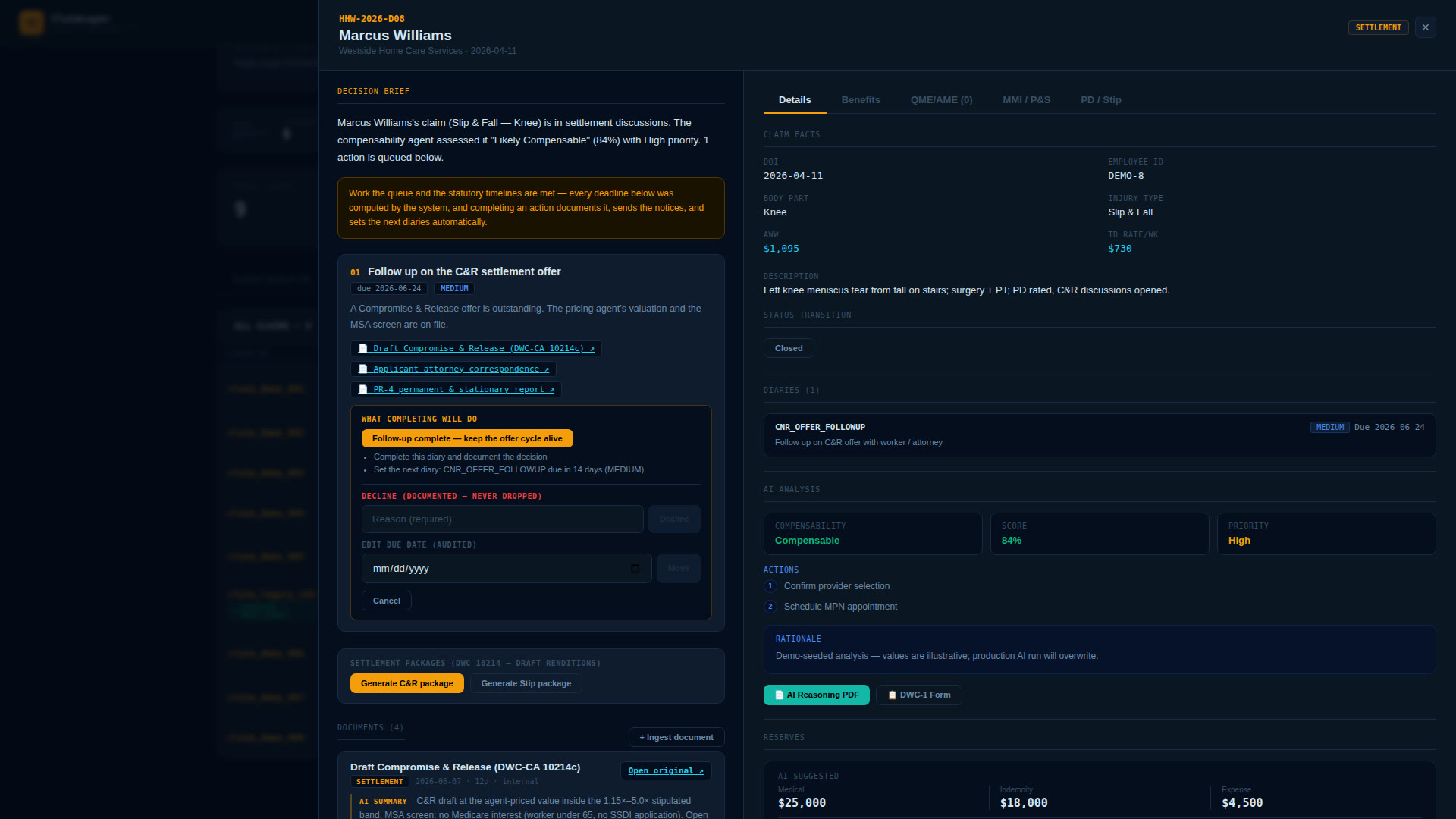
03Draft the next action, compute the statutory deadline the report triggers, and show the source document one click away.
04After human approval, document the decision, queue the notice, complete the diary, and set the successor deadline.
ClaimLayer decision drawer showing a prepared claim action with its source medical document and computed deadline
Guardrails

Built for a workflow where a wrong automated decision has consequences.

The pilot runs on the same operating contract as the product: AI can prepare, summarize, classify, and route. Licensed humans remain responsible for every consequential claim decision.

Decision safety

No automated adverse decision

ClaimLayer prepares, summarizes, classifies, and routes. It cannot deny a claim, stop or reduce benefits, or finalize a determination — compensability, temporary disability, and permanent disability stay licensed-human decisions, by construction.

Audit trail

Every model call is reviewable

Inputs, outputs, confidence, guardrails triggered, and human overrides are captured, so a reviewer can reconstruct exactly why an action was prepared.

System fit

Layer, not replacement

The pilot demonstrates the document-to-action layer first. System-of-record integration is scoped only after the workflow value is proven.

Success criteria

What the pilot measures.

These are the pilot's success thresholds to be measured on your documents — targets the engagement is designed to test, not guarantees of product performance.

≥90%target medical-document classification accuracy on agreed pilot categories
≥90%target claim/action routing accuracy on the supplied example set
30–50%*target reduction in adjuster review time for pilot document types
0production claim decisions during shadow mode
100%prepared actions tied to an audit packet
1production-readiness recommendation at the end

* Review-time reduction is a measured pilot target on your document mix, baselined against your current process — not a guaranteed outcome. The pilot reports the actual measured figure, whatever it is.

Limited-time founding pilot

Free for founding California teams

$7,500–$15,000
Waived through August.

The standard 30-day shadow pilot fee is $7,500–$15,000. It's waived for California TPAs and self-insured employers that begin a pilot through August — so you can judge the workflow value before any commitment.

No production PHI handling or system-of-record writeback is included in the founding pilot unless separately reviewed, scoped, and covered by a signed data agreement. See data handling.
Included

What you get

0150–200 medical-document shadow run across agreed pilot categories.
02Action-queue and audit-packet walkthrough for the sample set.
03Error analysis, override review, and workflow-fit findings.
04ROI estimate and a production-integration recommendation.
Data handling

Your claim data is gated, not assumed.

The default pilot uses synthetic or fully redacted medical documents. Real, unredacted documents are scoped only after a signed mutual NDA and data-processing agreement — and even then, the founding pilot runs in shadow mode with no system-of-record writeback. ClaimLayer is a reference implementation and active project, not a live system processing real claims; production use of any customer data is a separate, reviewed step.
Thanks — your request is in.
I'll reply within two business days to set up a 20-minute workflow review. — Akash
Next step

Start with a 20-minute workflow review.

Bring the current path for incoming medical reports. We'll compare where documents enter, who touches them, what deadlines matter, and whether a founding shadow pilot is worth running. No obligation.

Prefer email? akashdixit@gmail.com

Submitting shares only what you enter here. No claim data is sent through this form. We reply within two business days.